


Skip to content
(403) 768-2208Text UsFree 20-Minute Consultation
Stride Psychology
Guide

Adult Dyslexia Assessment in Calgary: What Happens and Who Does Them

What happens in a dyslexia assessment for adults, who does them in Calgary, how the report helps at school or work, and how to book.

Simren Jhuty, Director and Registered Psychologist

A man seen from behind, sitting on a stone ledge in a sunny city plaza with a closed notebook beside him

A dyslexia assessment for adults is a psychoeducational assessment. It includes an interview, a review of your school records, cognitive and academic testing in reading and spelling, rating scales, a feedback meeting and a written report with recommendations for study, work and daily life. Registered psychologists in Calgary do them, and no referral is needed.

What Happens in the Assessment?

At Stride Psychology, an adult psychoeducational assessment includes:

  1. Intake interview about your learning history and current challenges.
  2. Review of school records and earlier reports.
  3. Cognitive and academic achievement testing, including reading and spelling.
  4. Rating scales.
  5. Feedback meeting.
  6. Detailed written report.
  7. Recommendations for study, work and daily life.

It screens for learning disorders in reading (dyslexia), writing and math, and also for ADHD, anxiety and depression, and executive functioning difficulties.
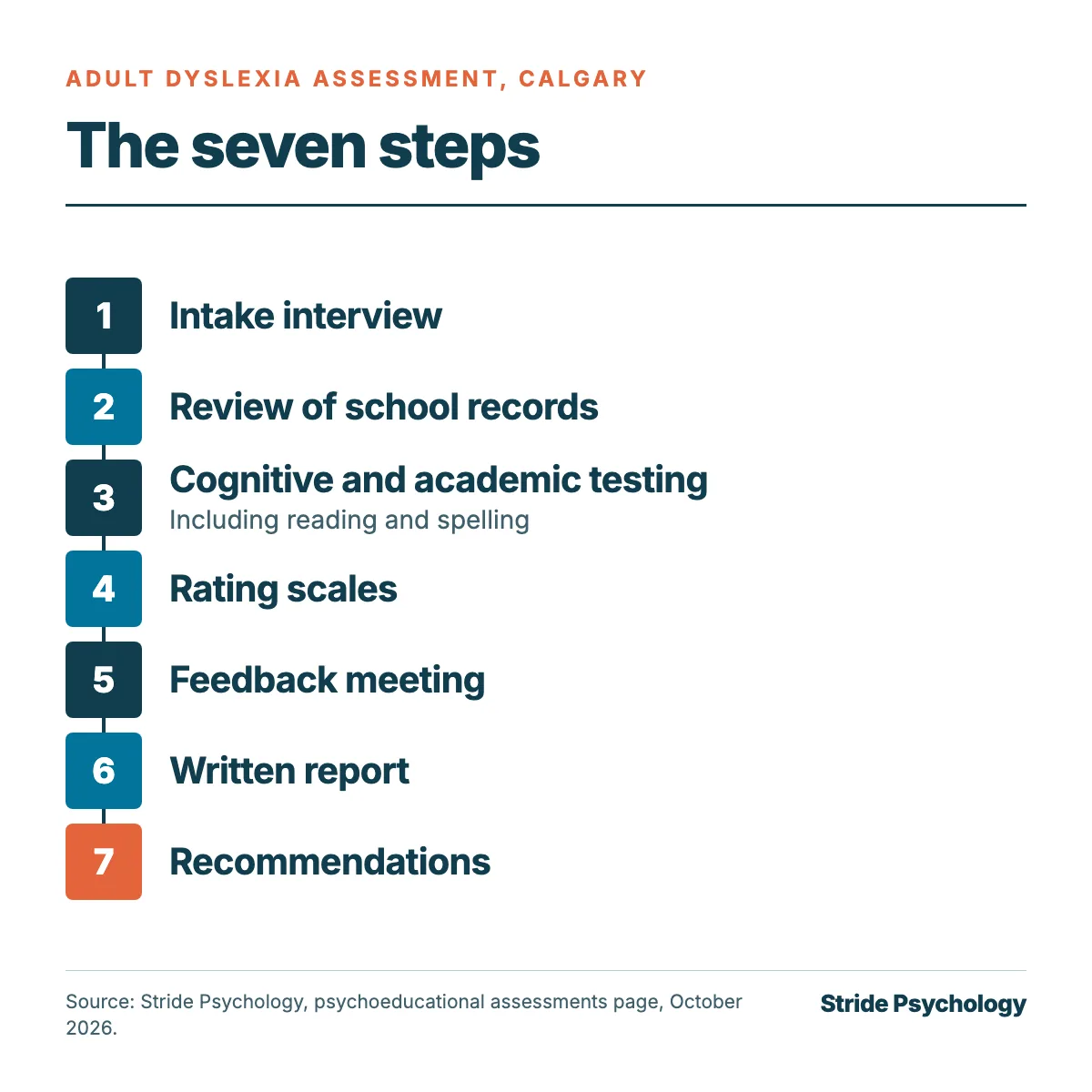
The seven steps of an adult dyslexia assessment: intake interview, review of school records, cognitive and academic testing including reading and spelling, rating scales, feedback meeting, written report, recommendations

Is It Too Late as an Adult?

No. We assess adults as well as children. An adult who has struggled with reading or spelling for years can be assessed at any point.

What Can the Report Do?

  • At college or university: request accommodations such as more time on exams, assistive technology like speech to text, or audio-recorded lectures. See our guide to assessments for university accommodations.
  • At work: support a request for workplace supports.
  • For yourself: words for something you have lived with for a long time.

Dyslexia, ADHD, or Both?

Reading difficulty and attention problems can affect each other. Because the assessment covers both, the report shows which is driving the difficulty and recommends supports for each. If attention is the only question, see our guide to adult ADHD assessments.

What to Bring

Old report cards, earlier assessment reports, notes from teachers or tutors, and any requirements from your school or employer.
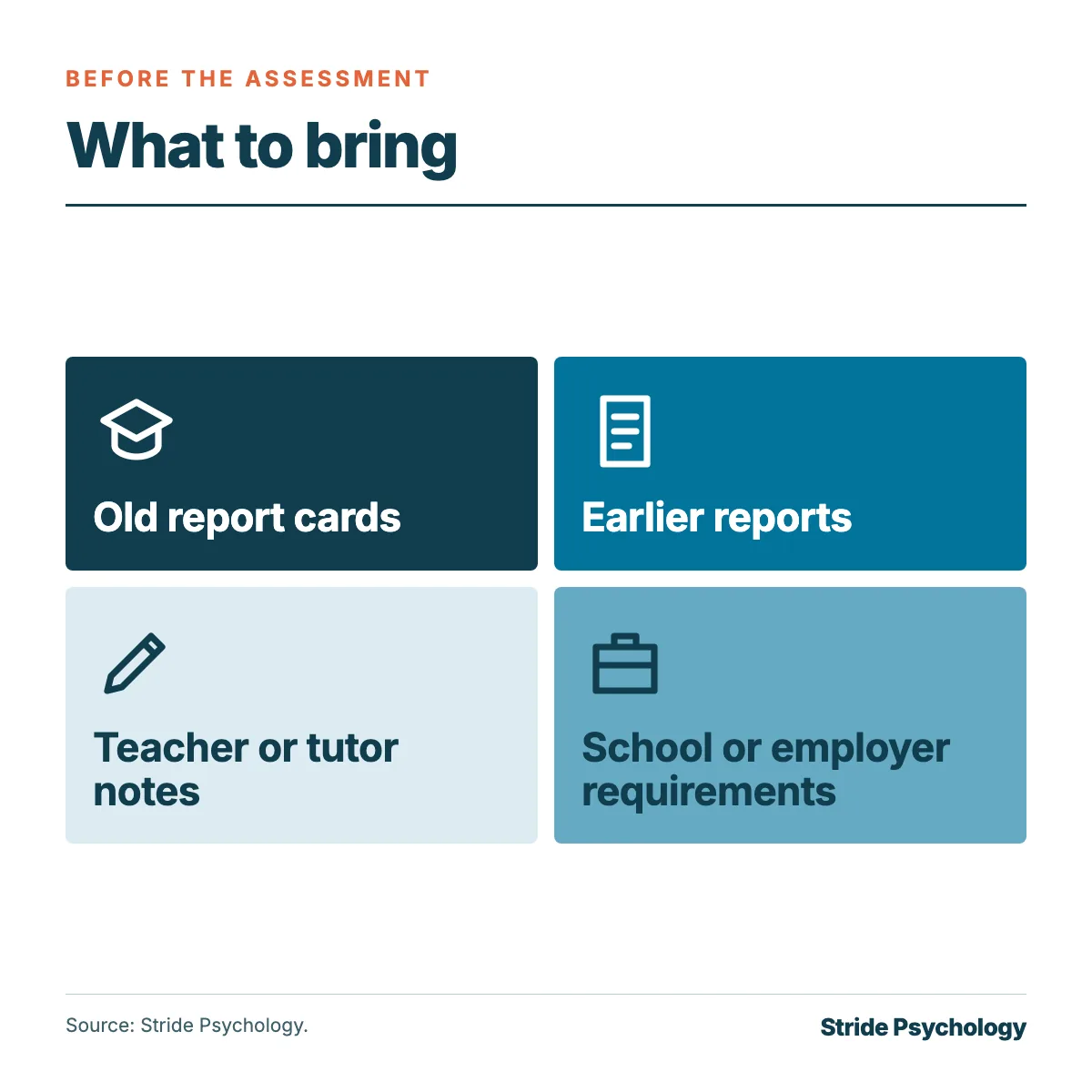
What to bring to an adult dyslexia assessment: old report cards, earlier assessment reports, notes from teachers or tutors, requirements from your school or employer

Cost and Booking

Most individual insurance plans provide coverage for assessment and counselling services. While Alberta Health Care does not currently cover these services, they may qualify as medical expenses on your tax return. The current fee is on our Fees page. Reach out through our contact page or give us a call to book a free 20-minute consultation.


Adult Dyslexia Assessment in Calgary: What Happens and Who Does Them

Frequently Asked Questions

01

What happens in a dyslexia assessment for adults?

A dyslexia assessment for adults at Stride Psychology is a psychoeducational assessment: an intake interview, a review of school records and earlier reports, cognitive and academic achievement testing including reading and spelling, rating scales, a feedback meeting, a detailed written report and recommendations for study, work and daily life.

02

Who does adult dyslexia assessments in Calgary?

Registered psychologists in Calgary do adult dyslexia assessments as part of a psychoeducational assessment. Stride Psychology assesses adults, including students in post-secondary programs, at its downtown Calgary office. The assessment screens for learning disorders in reading, writing and math, and also for ADHD, anxiety and executive functioning difficulties.

03

Is it too late to be assessed for dyslexia as an adult?

No. Psychoeducational assessments at Stride Psychology are done for adults as well as children. An adult who has had trouble with reading or spelling for years can be assessed at any point, and the written report explains the learning profile and recommends supports for study, work and daily life.

04

What can an adult do with a dyslexia assessment report?

An adult can use a psychoeducational report to request post-secondary accommodations, such as more time on exams, assistive technology like speech to text or audio-recorded lectures, and to ask for workplace supports. The report from Stride Psychology explains the learning profile and why each recommended accommodation fits.

05

Can an adult dyslexia assessment find ADHD too?

Yes. A psychoeducational assessment at Stride Psychology screens for ADHD as well as learning disorders, anxiety and depression. Reading difficulty and attention problems can affect each other, so assessing both in one assessment shows which is driving the difficulty, and the report recommends supports for each.

06

Do I need a referral for an adult dyslexia assessment?

No. An adult can book a psychoeducational assessment with a private psychologist in Calgary without a referral. At Stride Psychology you can reach out through the contact page or by phone to book a free 20-minute consultation, where the psychologist confirms whether the assessment fits your questions.

07

Is an adult dyslexia assessment covered by insurance?

Alberta Health Care does not currently cover psychological assessments, but they may qualify as medical expenses on your tax return. Most individual insurance plans provide coverage for assessment services, so check your plan's rules for psychology before you book. The current fee at Stride Psychology is on the practice's Fees page, and the receipt can be used for a claim.

08

What should I bring to an adult dyslexia assessment?

Bring any records that show your learning history: old report cards, earlier assessment reports, notes from teachers or tutors, and any requirements from your school's accessibility office or your employer. The review of documents is one of the steps of a psychoeducational assessment, and older records help the psychologist see how long the pattern has been there.

Free 20-Minute Consultation

Ready to Talk? We Can Help.

You deserve care that meets you where you are. We're here to support you.

Call (403) 768-2208