


Skip to content
(403) 768-2208Text UsFree 20-Minute Consultation
Stride Psychology
Guide

Autism Assessment for Children and Adults: What the Process Involves

What an autism assessment at Stride Psychology looks at, 4 to 6 hours of testing, the ADOS-2 and ADI-R, and how adult assessments differ.

Simren Jhuty, Director and Registered Psychologist

A calm, sunlit sensory corner with a soft rug, fidget toys, headphones and a plant

Some parents notice differences early: a toddler who does not point or share attention, who lines up toys, who is distressed by sounds others ignore. Some adults notice late, after years of feeling that social rules everyone else seemed to know were never explained to them. An autism assessment answers the question either way. This guide explains what it looks at, how it runs at Stride Psychology, and what the report can do.

What Is Autism?

Autism Spectrum Disorder (ASD) is a neurodevelopmental condition that shapes how a person communicates, connects with others and experiences the world around them. Signs of autism often appear in early childhood, but many people, especially those with more subtle traits, may not receive a diagnosis until later in life.

Autism can involve differences in social communication, in reading social cues, in adapting to changes in routine, and in managing sensory sensitivities. Many autistic people also have strengths that come with it: strong attention to detail, deep interests, creativity and their own ways of solving problems. The assessment looks at both.

Who Can Have an Autism Assessment?

We assess children, adolescents and adults, from 2.5 years up. Autism presents differently across the lifespan, and we provide neurodiversity-affirming care at every age: the aim is understanding, with supports that fit the person.

What Does an Autism Assessment Include?

An autism assessment at Stride Psychology may include:

  1. Intake and clinical interviews. With parents for a child, and with the adult for an adult, about development, daily life and what prompted the assessment.
  2. Review of relevant records. School reports, earlier assessments and medical history where it helps.
  3. 4 to 6 hours of testing. Cognitive, academic or other standardized measures as needed.
  4. Standardized autism-related measures. Such as the ADOS-2 and the ADI-R, along with other evidence-based diagnostic tools.
  5. Behavioural and social communication observations. Structured observation during the appointments.
  6. Norm-referenced questionnaires. Completed by several people, such as parents and teachers for a child.
  7. Additional interviews, as needed.
  8. Feedback meeting. Your psychologist explains the results.
  9. Comprehensive written report. The findings and recommendations in writing.
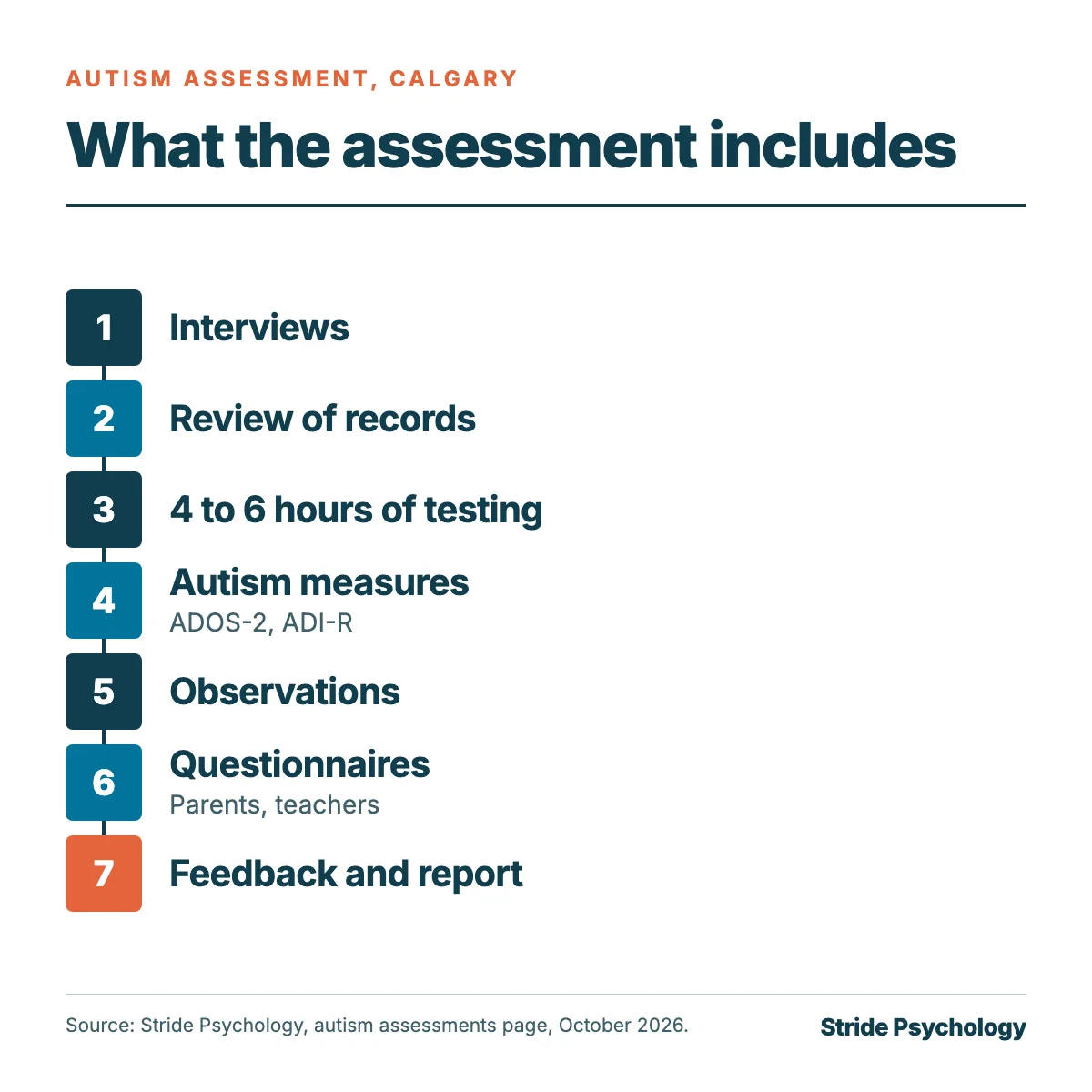
What an autism assessment includes: interviews, review of records, 4 to 6 hours of testing, autism measures such as the ADOS-2 and ADI-R, observations, questionnaires, feedback meeting and report

How Does an Autism Assessment Differ for Children and Adults?

For children, we gather input from parents and often from teachers, because social communication looks different at home and in a classroom.

For adults, we explore how traits have shown up across a lifetime, including the ways a person may have learned to mask or adapt. Many adults arrive with a long history of feeling different and few words for it. The assessment gives them the words, and a report they can use.

Can Autism Look Different from the Usual Picture?

Autism can look different from person to person. Some children and adults have traits that are more subtle, masked or misunderstood, which can make them harder to recognize without a thorough assessment. We look at the full picture: strengths, challenges, developmental history, sensory experiences and day-to-day functioning.

What Can the Result of an Autism Assessment Be?

Not every assessment results in a diagnosis, and that is okay. You receive a thorough written report outlining the findings and what they mean, with clear recommendations whether or not autism is part of the picture. When the findings point elsewhere, for example to anxiety or attention, the report says so. A social-emotional assessment or an ADHD assessment may be the next step in that case, and we explain why.

What Can an Autism Diagnosis Do for Me or My Child?

A lot. An autism diagnosis gives access to the right supports, accommodations and next steps. The report may be used for school supports, workplace accommodations, funding programs, counselling, or guidance from healthcare providers. For many individuals and families, the clarity brings relief and direction.

Does Insurance Cover an Autism Assessment?

Most individual insurance plans provide coverage for assessment and counselling services. While Alberta Health Care does not currently cover these services, they may qualify as medical expenses on your tax return. Your receipt can also be used for tax purposes. The fee depends on whether academic testing is required, and the current amount is on our Fees page.
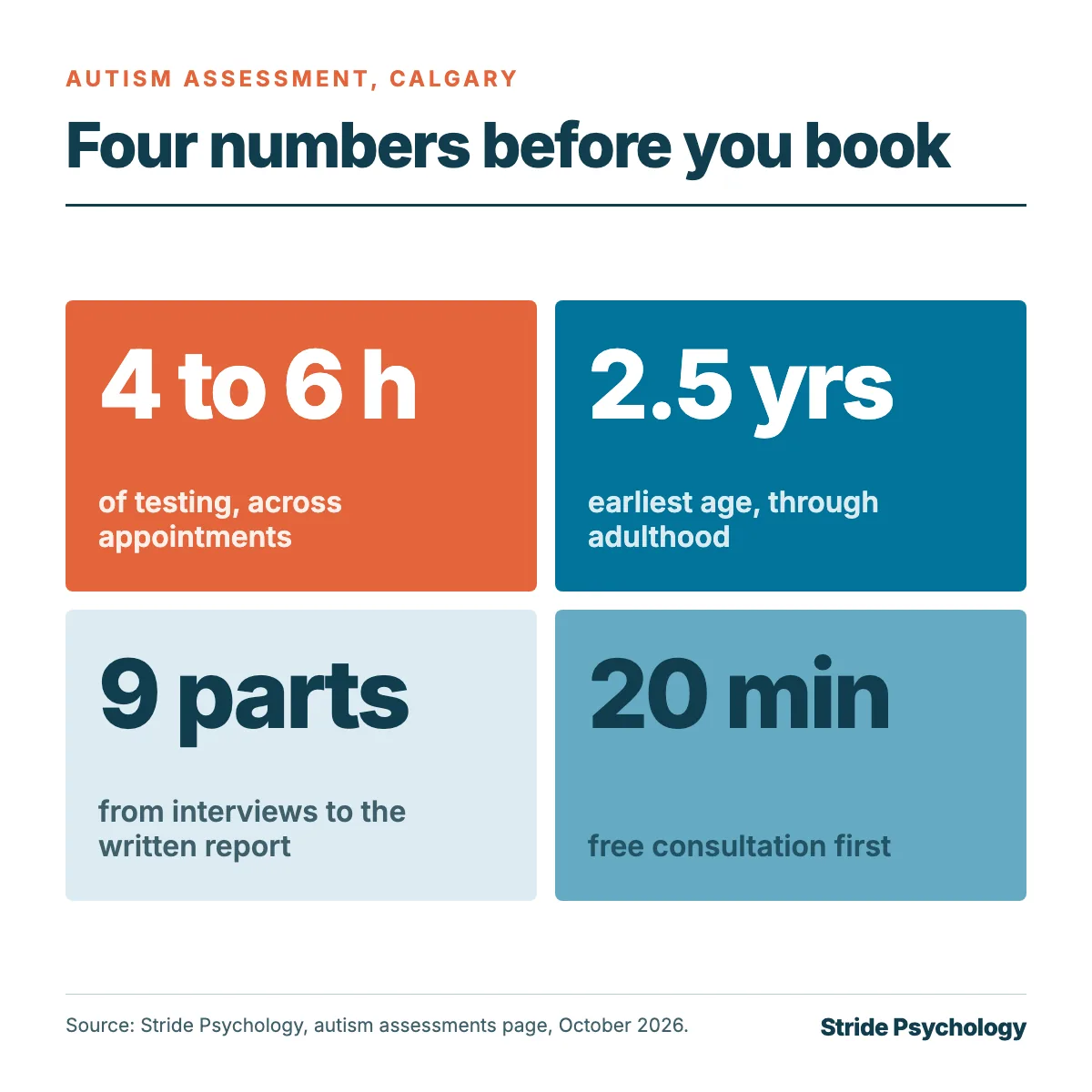
Autism assessment at Stride Psychology: 4 to 6 hours of testing, from 2.5 years to adulthood, nine parts from interviews to the written report, a free 20-minute consultation first

How Do I Book an Autism Assessment in Calgary?

Reach out through our contact page or give us a call. In a free 20-minute consultation we talk about what you are noticing, whether an autism assessment is the right next step, and what the schedule would look like.

Sources

  1. Autism: Overview, Public Health Agency of Canada

Autism Assessment for Children and Adults: What the Process Involves

Frequently Asked Questions

01

What is an autism assessment and what does it involve?

An autism assessment is a comprehensive evaluation that looks at social communication, repetitive behaviours, sensory sensitivities and developmental history. At Stride Psychology it involves clinical interviews, standardized testing, structured observation of behaviour and social communication, and questionnaires completed by several people. For children we gather input from parents and often teachers. For adults we explore how traits have shown up across their lifetime, including ways they may have learned to mask or adapt.

02

How long does autism testing take?

An autism assessment at Stride Psychology includes 4 to 6 hours of testing, which may include cognitive, academic or other standardized measures alongside autism-specific tools such as the ADOS-2 and the ADI-R. The testing is spread across appointments, with intake interviews before it and a feedback meeting after. The written report follows the feedback meeting. We outline the schedule for your situation during the free 20-minute consultation.

03

At what age can someone be assessed for autism?

We assess people of all ages for autism, from young children at 2.5 years to adults. A parent with concerns about a toddler, a teenager who has always felt different from peers, and an adult who has wondered for years can each be assessed, with measures suited to their age. Signs of autism often appear in early childhood, but people with more subtle traits may not receive a diagnosis until later in life.

04

Does insurance cover an autism assessment?

Alberta Health Care does not currently cover psychological services, so an autism assessment at Stride Psychology is paid privately. Most individual insurance plans provide coverage for assessment services, and the receipt can be submitted for reimbursement when the plan lists psychology, psychotherapy or counselling. The assessment may also qualify as a medical expense on your tax return. The current fee, which depends on whether academic testing is required, is on our Fees page.

05

What if my child or I do not fit the stereotype of autism?

Autism can look different from person to person. Some children and adults have traits that are more subtle, masked or misunderstood, which makes them harder to recognize without a thorough assessment. At Stride Psychology we look at the full picture: strengths, challenges, developmental history, sensory experiences and day-to-day functioning. The assessment measures how a person communicates, relates and experiences the world, whatever they look like from the outside.

06

Will an autism assessment result in a formal diagnosis?

Not every autism assessment results in a diagnosis, and that is okay. Whatever the outcome, you receive a thorough written report outlining the findings and what they mean, with clear recommendations whether or not autism is part of the picture. Understanding what is going on is always the goal. When the findings point to something else, such as anxiety or attention, the report says so and suggests the next step.

07

What can we do with an autism diagnosis once we have one?

An autism diagnosis gives access to the right supports, accommodations and next steps. The assessment report may be used for school supports, workplace accommodations, funding programs, counselling, or guidance from healthcare providers. For many individuals and families, the clarity itself brings relief and direction, because it explains experiences they have had for years and shows what kind of help fits.

08

How is an autism assessment different for adults?

For an adult, an autism assessment explores how traits have shown up across their whole life: childhood, school, work and relationships, including the ways they may have learned to mask or adapt. The interviews ask for developmental history where it is available. The standardized measures and observations are suited to adults. The report focuses on the supports and accommodations that fit adult life, such as workplace accommodations.

Free 20-Minute Consultation

Ready to Talk? We Can Help.

You deserve care that meets you where you are. We're here to support you.

Call (403) 768-2208