


Skip to content
(403) 768-2208Text UsFree 20-Minute Consultation
Stride Psychology
Guide

Signs of a Learning Disability in Children, and Where to Get Tested in Calgary

Signs a child may have a learning disability in reading, writing or math, what testing looks at, and where Calgary families can get an assessment.

Simren Jhuty, Director and Registered Psychologist

A bright, sunlit study corner with a notebook, pencils and a tablet on a white desk

Signs that a child may have a learning disability include low or falling grades, trouble with reading, writing, spelling or math, forgetting what was taught, and homework that takes far longer than it should. In Calgary, a psychoeducational assessment with a registered psychologist finds out what is behind the pattern, and no referral is needed.

What Are the Signs of a Learning Disability?

Parents often notice several of these together:

  • Low or declining grades.
  • Difficulty with reading, writing, spelling, math, or remembering what was taught.
  • Homework that takes much longer than expected, or does not get finished.
  • Trouble staying focused or following instructions.
  • Anxiety around school, tests or performance.
  • Outbursts, frustration or meltdowns about school.
  • Avoiding school, homework, or conversations about school.
  • Low confidence or negative comments about themselves as a learner.
  • Teacher concerns about learning, attention, behaviour or participation.

One hard term can have many causes. An assessment makes the most sense when the pattern lasts across subjects or years, even with effort and help.
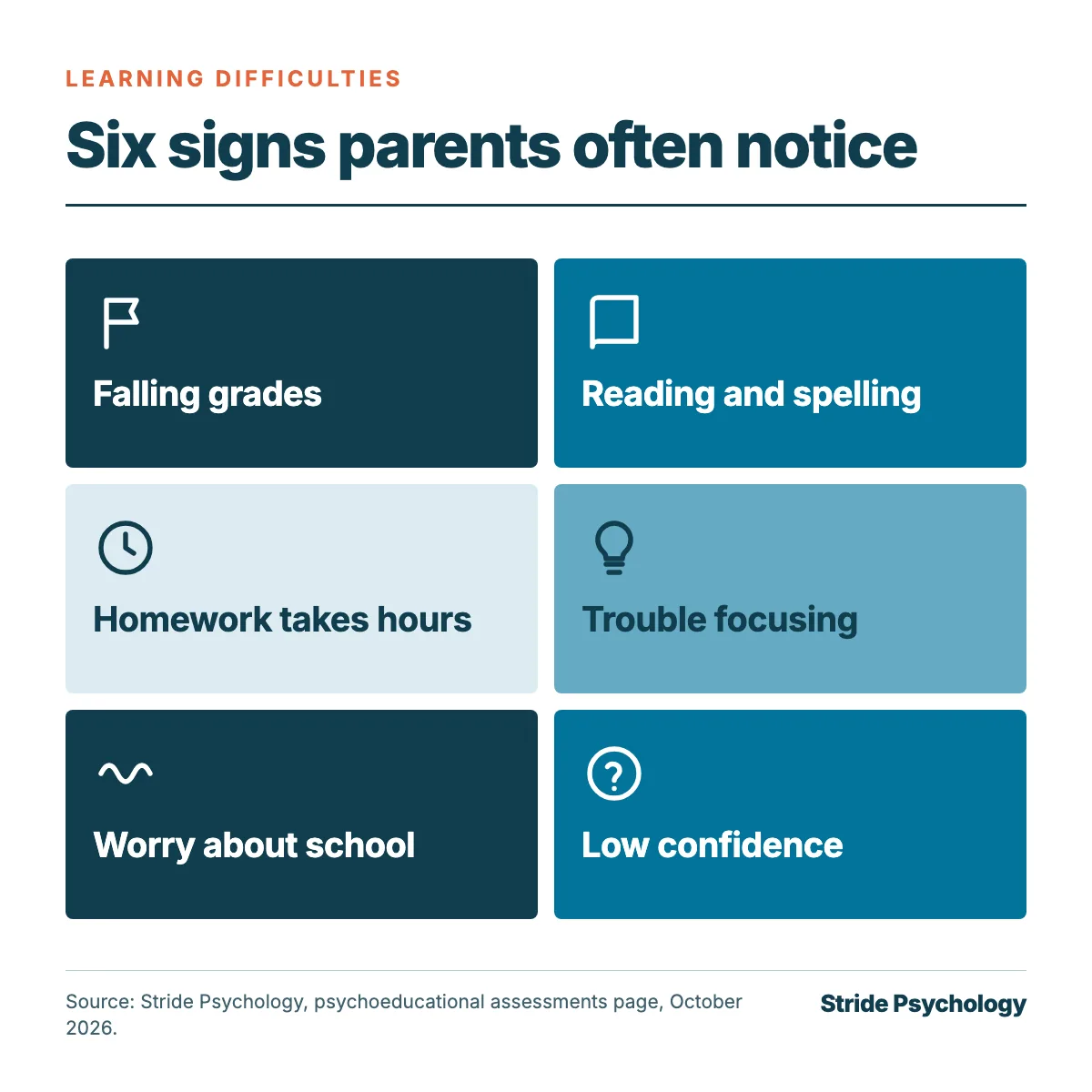
Six signs of a learning difficulty parents often notice: falling grades, trouble with reading and spelling, homework that takes hours, trouble focusing, worry about school, low confidence

What Does Testing Look At?

A psychoeducational assessment identifies strengths and weaknesses in a student's learning profile. It screens for learning disorders in reading (dyslexia), writing (dysgraphia) and mathematics (dyscalculia), and also for ADHD, anxiety and depression, intellectual disabilities, emotional dysregulation, speech and language delays, executive functioning difficulties, and motor difficulties.

The steps are an intake interview, a review of report cards and earlier reports, cognitive and academic testing, rating scales from the student, parents and teachers, a feedback meeting, a written report, and recommendations.
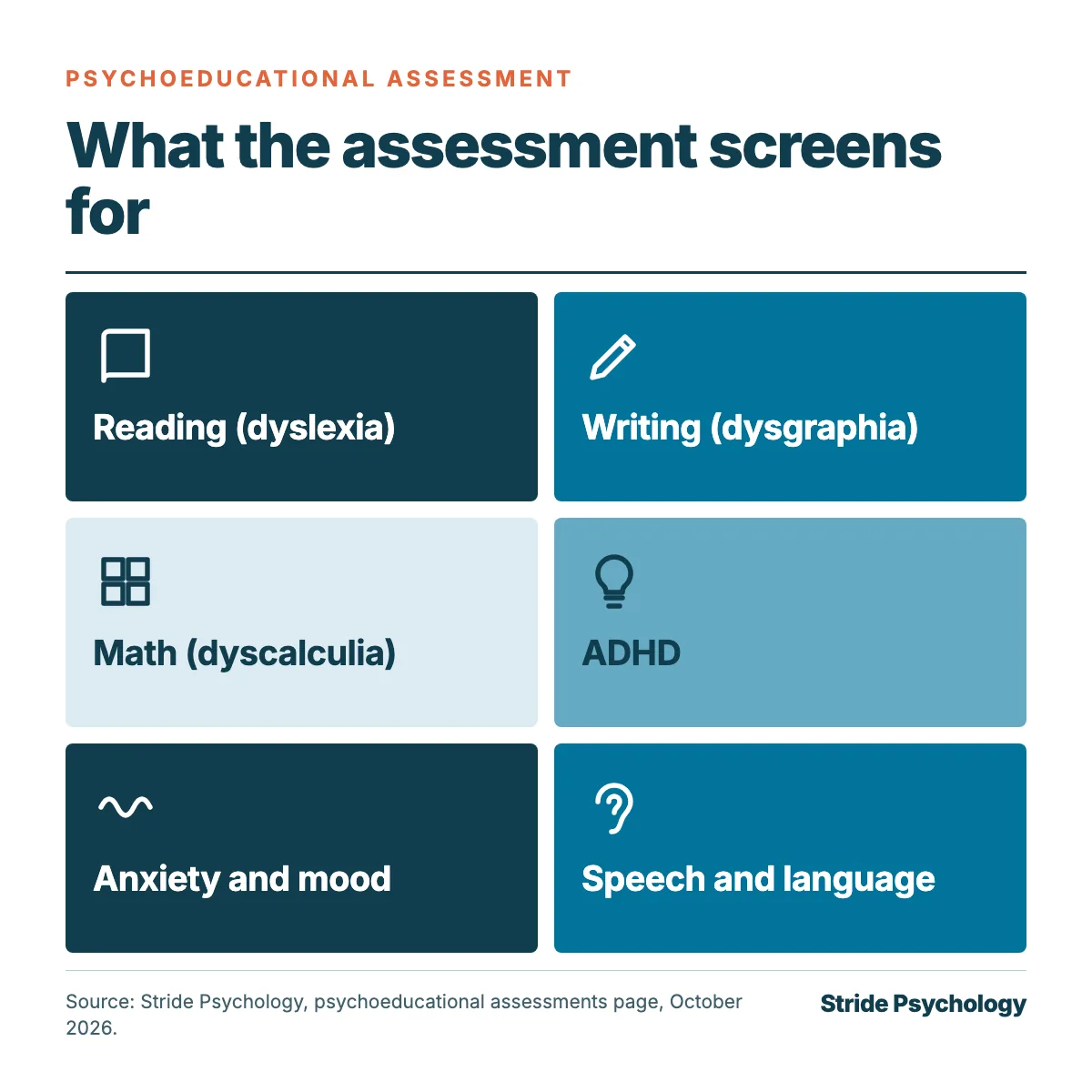
A psychoeducational assessment screens for reading (dyslexia), writing (dysgraphia) and math (dyscalculia) disorders, ADHD, anxiety and mood, and speech and language delays, among others

Where Can My Child Be Tested in Calgary?

You can book directly with a private registered psychologist. Stride Psychology does psychoeducational assessments in downtown Calgary for students from Kindergarten to Grade 12. Our guide on how to choose a psychologist for a psychoeducational assessment lists what to compare before you book.

What If It Is a Language Problem?

Some reading and writing difficulties start with how a child understands or uses spoken language. A speech and language assessment focuses on communication. When both learning and communication seem involved, doing both assessments shows how the two connect.

What Happens After Testing?

The written report explains your child's learning profile and lists accommodations a school can put in place, such as more time on tests, assistive technology, or a quiet exam room. Most individual insurance plans provide coverage for assessment and counselling services. While Alberta Health Care does not currently cover these services, they may qualify as medical expenses on your tax return. The current fee is on our Fees page.

How to Get Started

Reach out through our contact page or give us a call to book a free 20-minute consultation.

Signs of a Learning Disability in Children, and Where to Get Tested in Calgary

Frequently Asked Questions

01

What are the signs my child has a learning disability?

Signs a child may have a learning disability include low or falling grades, trouble with reading, writing, spelling or math, forgetting what was taught, homework that takes much longer than expected, avoiding school or homework, and negative comments about themselves as a learner. A psychoeducational assessment at Stride Psychology can find out what is behind them.

02

Where in Calgary can a child be tested for a learning disability?

Calgary families can book a learning disability assessment, called a psychoeducational assessment, with a private registered psychologist, without a referral. Stride Psychology does psychoeducational assessments in downtown Calgary for students from Kindergarten to Grade 12, with cognitive and academic testing, rating scales from parents and teachers, and a written report.

03

What learning disabilities can a psychoeducational assessment find?

A psychoeducational assessment at Stride Psychology screens for learning disorders in reading, known as dyslexia, writing, known as dysgraphia, and mathematics, known as dyscalculia. It also screens for ADHD, anxiety and depression, intellectual disabilities, emotional dysregulation, speech and language delays, executive functioning deficits, and fine and gross motor difficulties.

04

How early can a learning disability be identified?

Psychoeducational assessments at Stride Psychology are done for students from Kindergarten onward. The tests are chosen to suit the child's age, so a young child and a teenager follow the same steps with different measures. The psychologist explains in the free consultation whether an assessment is likely to be useful at your child's age.

05

Is it a learning disability or just a hard year at school?

A single hard term can have many causes, such as a move, a new teacher or stress at home. An assessment makes the most sense when the pattern continues across subjects or years despite effort and support. When the pattern lasts, a psychoeducational assessment separates a learning difficulty from other causes and explains it in a written report.

06

What does the school do with a learning disability assessment?

A school uses a psychoeducational report to plan supports and accommodations for the student. The report from Stride Psychology lists recommended accommodations, such as more time on tests and exams, assistive technology like speech to text, a quiet room for exams, or a modified exam schedule, and explains why each one fits the child.

07

Is a learning disability assessment covered by insurance?

Most individual insurance plans provide coverage for assessment services, so check your plan's rules for psychology before you book. Alberta Health Care does not currently cover these services, but they may qualify as medical expenses on your tax return. The current fee is on the Stride Psychology Fees page.

08

Can a learning problem be a speech or language issue?

Yes. Some reading and writing difficulties come from how a child understands or uses spoken language. A speech and language assessment focuses on communication, while a psychoeducational assessment looks at learning, thinking and emotions more broadly. When both seem involved, Stride Psychology can complete both assessments to show how the two areas connect.

Free 20-Minute Consultation

Ready to Talk? We Can Help.

You deserve care that meets you where you are. We're here to support you.

Call (403) 768-2208