


Skip to content
(403) 768-2208Text UsFree 20-Minute Consultation
Stride Psychology
Guide

What a Psychoeducational Assessment Looks at, and What the Report Gives You

What a psychoeducational assessment screens for, its seven steps, the school accommodations a report supports and how insurance works in Calgary.

Simren Jhuty, Director and Registered Psychologist

A bright, sunlit study corner with a notebook, pencils and a tablet on a white desk

A report card comes home with grades that do not match the effort you have watched your child put in. Homework that should take twenty minutes takes two hours. A teacher mentions attention, or reading, or behaviour. When learning feels harder than it should, a psychoeducational assessment finds out what may be standing in the way. This guide explains what it looks at, how it runs, and what you can do with the report.

What Does a Psychoeducational Assessment Look At?

A psychoeducational assessment identifies areas of strength and weakness in a student's learning profile. It answers questions about cognitive, academic, social, emotional, behavioural and adaptive functioning: how a student thinks and remembers, how they read, write and do math, and how attention, mood and behaviour affect their school day.

We complete these assessments for students of all ages, from Kindergarten to Grade 12, and for adults in post-secondary institutions.

The assessment screens for:

  • Learning disorders in reading (dyslexia), writing (dysgraphia) and mathematics (dyscalculia)
  • ADHD
  • Anxiety and depression
  • Intellectual disabilities
  • Behavioural challenges
  • Emotional dysregulation
  • Speech and language delays
  • Executive functioning deficits
  • Fine and gross motor impairment

One assessment can look at several of these at once. That matters, because a student's difficulties rarely fit one clear label from the outside.

What Are the Seven Steps of a Psychoeducational Assessment?

  1. Intake and interviews. We talk with you, and with your child where it fits their age, about what you are seeing at home and what the school is reporting.
  2. Review of documents. Report cards, previous assessment reports and anything else that shows how long the pattern has been there.
  3. Cognitive and academic achievement testing. Structured tasks that measure thinking and memory alongside reading, writing and math skills.
  4. Rating scales from several people. The student, a parent or guardian and teachers each complete questionnaires, so we see how things look in every setting.
  5. Feedback meeting. Your psychologist explains what the testing found and what it means, and answers your questions.
  6. Detailed written report. The findings in writing, with the reasoning behind them.
  7. Recommendations and accommodations. Specific supports for school, home, work and daily life, written for this student.
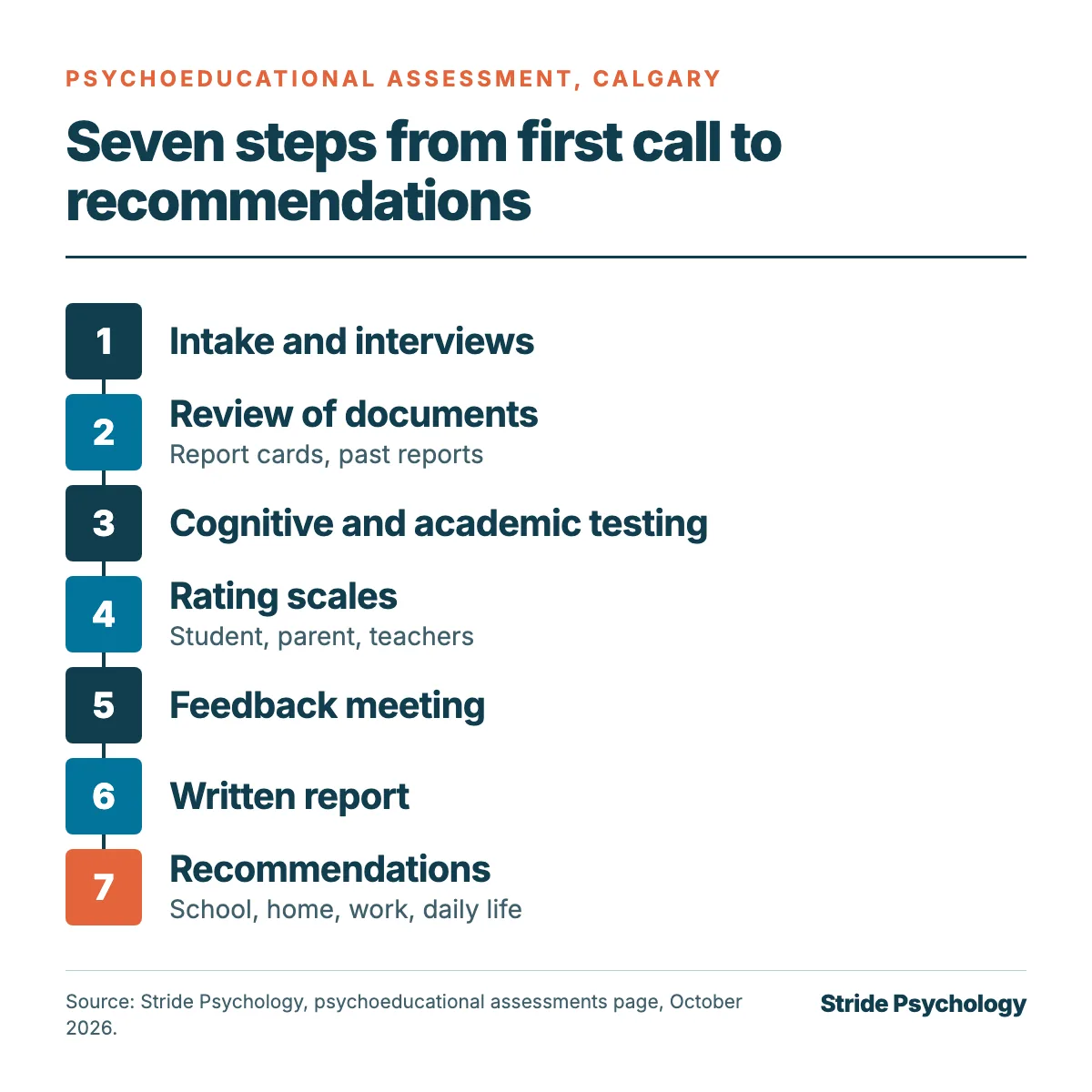
The seven steps of a psychoeducational assessment: intake and interviews, review of documents, cognitive and academic testing, rating scales from several people, feedback meeting, written report, recommendations and accommodations

How Can the Report Help at School?

The report is written so that a school or a post-secondary accessibility office can act on it. Common academic accommodations include:

  • More time to complete tests and exams
  • Access to a laptop and assistive technology, such as speech to text
  • Permission to audio-record lectures
  • Taking exams in a quiet, supervised environment
  • A modified test and exam schedule

The report also gives teachers and parents the same picture of how the student learns, which makes the conversation about supports easier on both sides.
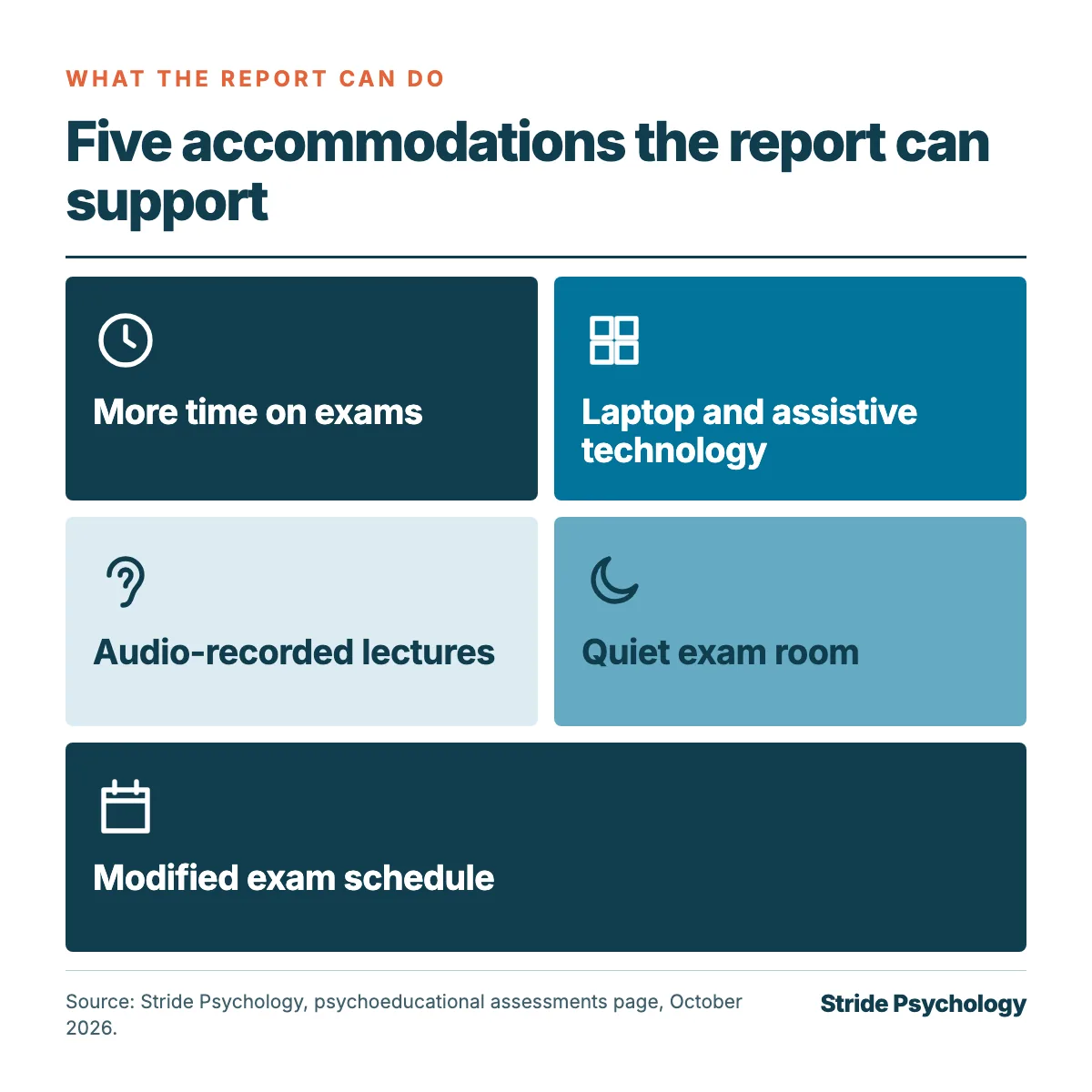
Common academic accommodations a psychoeducational report can support: more time on exams, a laptop and assistive technology, audio-recorded lectures, a quiet exam room, a modified exam schedule

Does a Psychoeducational Assessment Look for ADHD?

Yes, a psychoeducational assessment can assess for ADHD. It also looks at learning disorders, intellectual disabilities, anxiety, depression and other concerns, so it is the broader of the two. If attention is the main concern and learning is otherwise on track, our ADHD assessment may be the better fit. It focuses on attention alone. We help you choose during the consultation, and we say so if the narrower assessment is enough.

What Are the Signs a Child May Need an Assessment?

Parents often reach out after noticing a few of these:

  • Low or declining grades
  • Difficulty with reading, writing, spelling, math, or remembering what was taught
  • Homework that takes much longer than expected, or does not get finished
  • Trouble staying focused or following instructions
  • Anxiety around school, tests or performance
  • Emotional outbursts, frustration or meltdowns related to school
  • Avoiding school, homework or conversations about school
  • Low confidence or negative comments about themselves as a learner
  • Teacher concerns about learning, attention, behaviour or participation

Each of these is a question worth answering, whatever the assessment finds.

Does Insurance Cover a Psychoeducational Assessment?

Most individual insurance plans provide coverage for assessment and counselling services. While Alberta Health Care does not currently cover these services, they may qualify as medical expenses on your tax return. Your receipt can also be used for tax purposes. Check your plan before you book. Our Fees page lists the current fee and the payment methods.

How Do I Book a Psychoeducational Assessment?

Reach out through our contact page or give us a call. We start with a free 20-minute consultation, connect you with the right service, answer your questions and get you scheduled as soon as possible.


What a Psychoeducational Assessment Looks at, and What the Report Gives You

Frequently Asked Questions

01

What is a psychoeducational assessment?

A psychoeducational assessment identifies areas of strength and weakness in a student's learning profile. It answers questions about cognitive, academic, social, emotional, behavioural and adaptive functioning, through an interview, cognitive and academic testing, rating scales from the student, a parent and teachers, and a review of report cards and past reports. The result is a detailed written report with recommendations and accommodations for school, home, work and daily life.

02

Does insurance cover a psychoeducational assessment?

Most individual insurance plans provide coverage for a psychoeducational assessment at Stride Psychology, so check your plan's rules for psychology, psychotherapy or counselling before you book. Alberta Health Care does not currently cover psychological services. The assessment may also qualify as a medical expense on your tax return. The current fee and the payment methods are listed on our Fees page.

03

What does a psychoeducational assessment screen for?

A psychoeducational assessment at Stride Psychology screens for learning disorders in reading (dyslexia), writing (dysgraphia) and mathematics (dyscalculia), ADHD, anxiety and depression, intellectual disabilities, behavioural challenges, emotional dysregulation, speech and language delays, executive functioning deficits, and fine and gross motor impairment. One assessment can look at several of these, which is why it suits a student whose difficulties do not fit one clear label.

04

Who is a psychoeducational assessment for?

A psychoeducational assessment is for students of all ages, from Kindergarten to Grade 12, and for adults in post-secondary institutions. Parents usually ask for one when a child's grades are low or falling, homework takes far longer than expected, or a teacher raises concerns about learning, attention or behaviour. Adults ask for one when college or university work is harder than their effort suggests it should be.

05

How long does a psychoeducational assessment take?

A psychoeducational assessment runs across more than one appointment: an intake interview, cognitive and academic achievement testing, rating scales completed by the student, a parent or guardian and teachers, a feedback meeting, and then the written report. The number of appointments depends on the student and the questions being asked. We outline the schedule and when to expect the report during the free 20-minute consultation.

06

What school accommodations can a psychoeducational report support?

A psychoeducational report can support common academic accommodations such as more time to complete tests and exams, access to a laptop and assistive technology like speech to text, permission to audio-record lectures, taking exams in a quiet supervised environment, and a modified test and exam schedule. The report explains why each accommodation fits the student, which is what a school or post-secondary accessibility office needs to put it in place.

07

Does a psychoeducational assessment diagnose ADHD?

Yes. A psychoeducational assessment can assess for ADHD, as well as learning disorders, intellectual disabilities, anxiety, depression and other concerns that may be affecting functioning. If attention is the main concern and learning is otherwise on track, our ADHD assessment may be the better fit, because it focuses on attention alone. We help you choose between the two during the consultation.

08

What are signs that my child may need a psychoeducational assessment?

Signs a child may need a psychoeducational assessment include low or declining grades, difficulty with reading, writing, spelling, math or remembering what was taught, homework that takes much longer than expected, trouble staying focused or following instructions, anxiety around school or tests, outbursts or meltdowns related to school, avoiding school or homework, low confidence as a learner, and teacher concerns about learning, attention, behaviour or participation.

Free 20-Minute Consultation

Ready to Talk? We Can Help.

You deserve care that meets you where you are. We're here to support you.

Call (403) 768-2208