

Skip to content
(403) 768-2208Text UsFree 20-Minute Consultation
Stride Psychology
Guide

What a Speech and Language Assessment Finds, and How It Differs from a Psychoeducational Assessment

What a speech and language assessment can identify, what it includes, how it differs from a psychoeducational assessment, and where to get one in Calgary.

Simren Jhuty, Director and Registered Psychologist

A child during a speech and language assessment

A speech and language assessment can identify language delays, speech sound disorders, social communication delays, motor speech disorders, stuttering and articulation disorders. It focuses on communication. A psychoeducational assessment looks more broadly at learning, thinking and emotions. When both are concerns, doing both shows how they connect.

What Can a Speech and Language Assessment Find?

At Stride Psychology, a speech and language assessment screens for:

  • Expressive and receptive language delays.
  • Speech sound disorders.
  • Social communication delays.
  • Motor speech disorders.
  • Fluency disorders, such as stuttering.
  • Articulation disorders.

It also looks at how these skills affect communication, social life, emotions, behaviour and school.
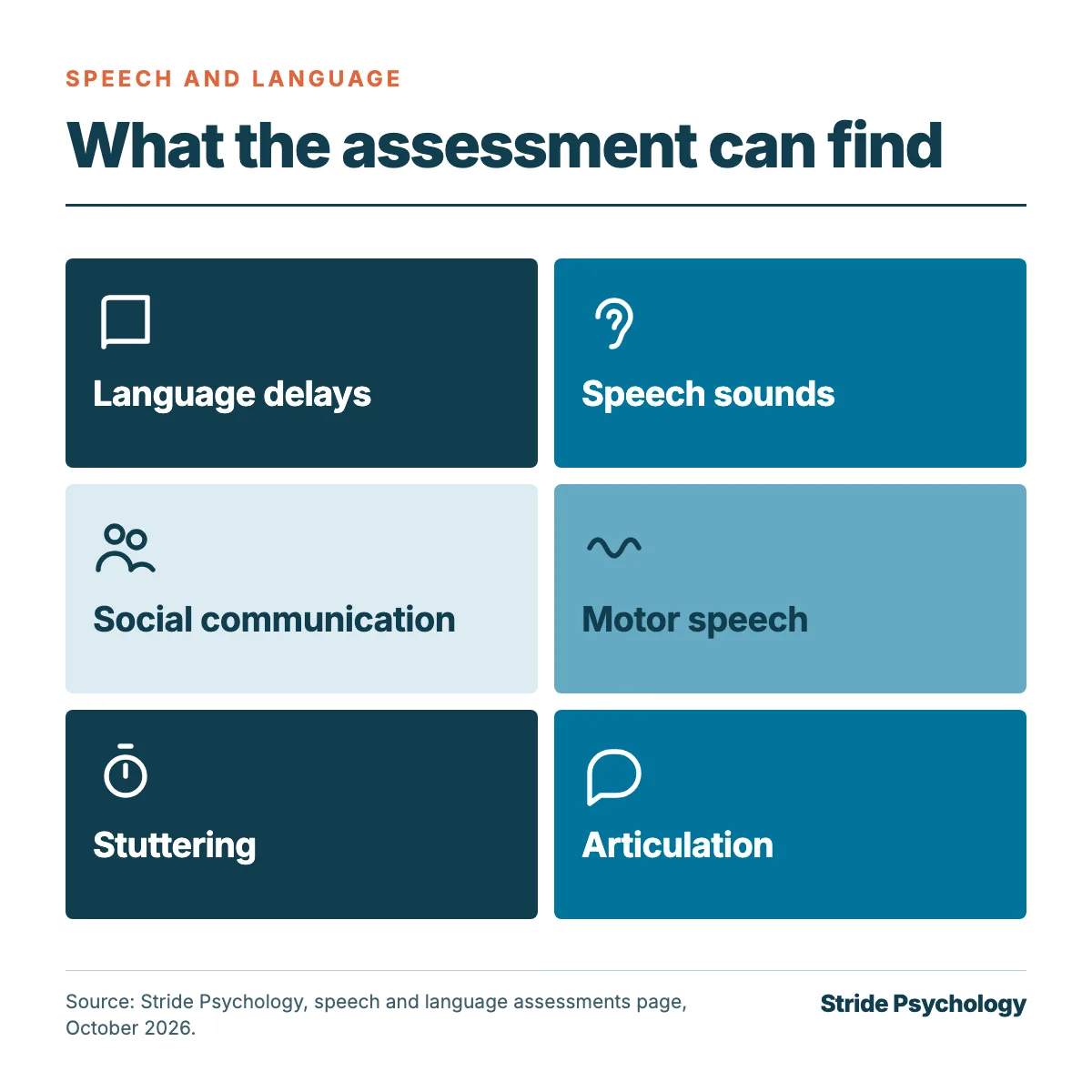
What a speech and language assessment can find: language delays, speech sound disorders, social communication delays, motor speech disorders, stuttering, articulation disorders

How Is It Different from a Psychoeducational Assessment?

A speech and language assessment focuses on how a person understands and uses spoken language and produces speech. A psychoeducational assessment takes a broader look at learning, thinking, academic skills and social-emotional development.

When a child has trouble with both communication and learning, completing both assessments shows how the two areas are connected and which supports will help most.

What the Assessment Includes

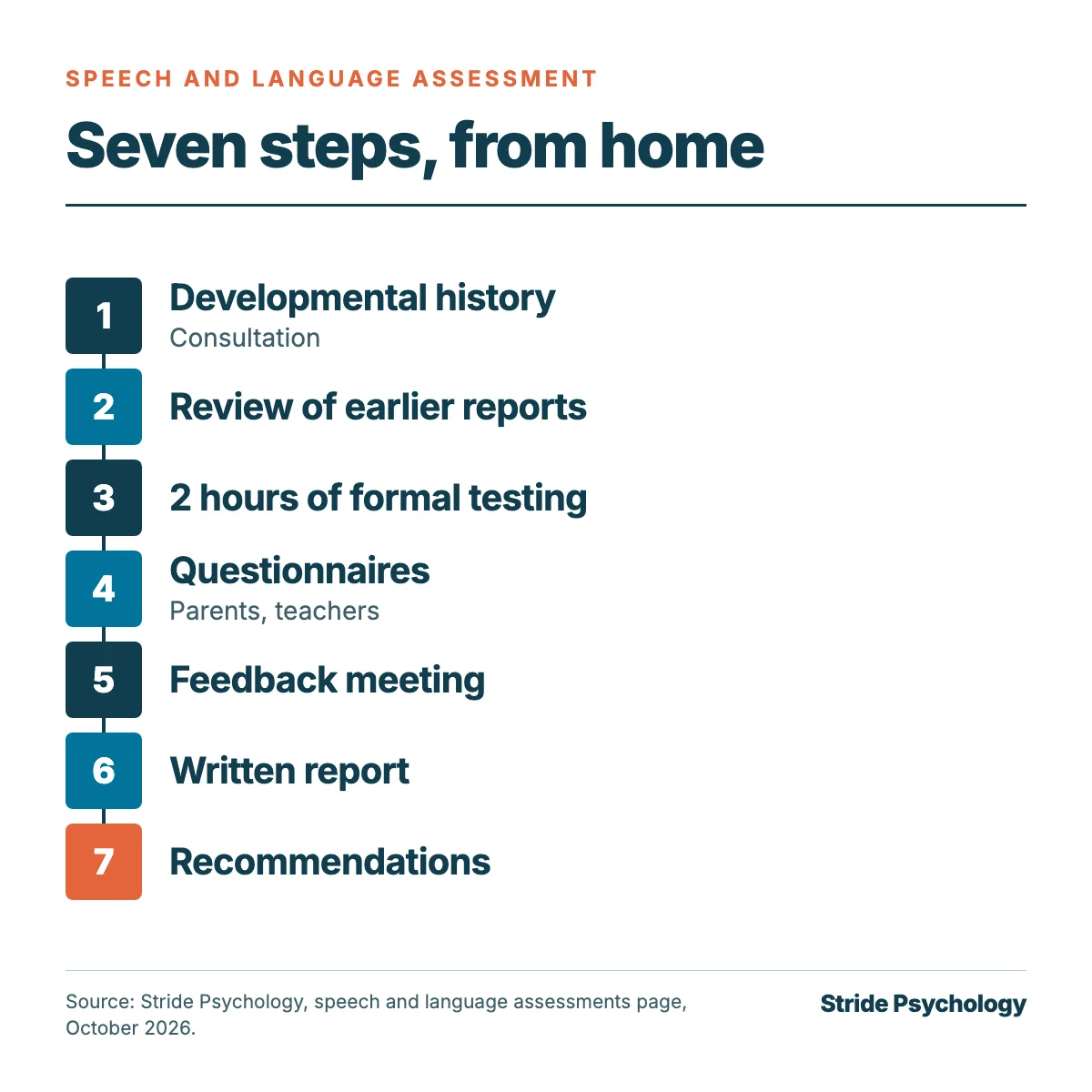
  1. Consultation to gather medical and developmental history.
  2. Review of earlier evaluations and school reports.
  3. 2 hours of formal testing.
  4. Questionnaires and rating scales from more than one person.
  5. Feedback meeting.
  6. Detailed written report.
  7. Recommendations for school and home.

The seven steps of a speech and language assessment: developmental history, review of earlier reports, 2 hours of formal testing, questionnaires from parents and teachers, feedback meeting, written report, recommendations

Who Does It, and Where?

Our speech language pathologist does the assessment through a virtual assessment, from your home. That also makes it available to families outside our usual service area. We see people aged 5 and up. You can read about our speech language pathologist on our team page.

What the Results Are Used For

The report can be used to access school-based speech and language services, private therapy, funding supports, or classroom and workplace accommodations. It gives everyone involved a shared picture of the person's communication and a plan for next steps.

Cost and Booking

The current fee is on our Fees page. Reach out through our contact page or give us a call to book a free 20-minute consultation.


What a Speech and Language Assessment Finds, and How It Differs from a Psychoeducational Assessment

Frequently Asked Questions

01

What can a speech and language assessment find?

A speech and language assessment at Stride Psychology can identify expressive and receptive language delays, speech sound disorders, social communication delays, motor speech disorders, fluency disorders such as stuttering, and articulation disorders. It shows how these skills affect communication, learning, social life and behaviour, and what support would help.

02

Which Calgary clinics do speech and language assessments for children?

Several private clinics in Calgary offer speech and language assessments for children. Stride Psychology offers them for people aged 5 and up, done by its speech language pathologist through a virtual assessment from home, with a developmental history, 2 hours of formal testing, questionnaires, a feedback meeting and a detailed written report.

03

How is a speech and language assessment different from a psychoeducational assessment?

A speech and language assessment focuses on communication: how a person understands and uses spoken language and produces speech. A psychoeducational assessment takes a broader look at learning, thinking, academic skills and social-emotional development. When both communication and learning are concerns, completing both shows how the two areas are connected.

04

What does a speech and language assessment include?

A speech and language assessment at Stride Psychology includes a consultation to gather medical and developmental history, a review of earlier evaluations and school reports, 2 hours of formal testing, questionnaires and rating scales from more than one person, a feedback meeting, a detailed written report, and recommendations for school and home.

05

Can a speech and language assessment be done online?

Yes. Stride Psychology brings its speech and language assessments to your home through virtual assessments, which also makes them available to families outside its usual service area. The speech language pathologist explains how each part of the testing is done online during the first consultation, so you know how to set up.

06

Who does speech and language assessments at Stride Psychology?

Speech and language assessments at Stride Psychology are done by the practice's speech language pathologist, a professional trained in communication, speech and language. You can read about the speech language pathologist's background, the ages they see and their services on the practice's team page, and ask any questions in the free consultation.

07

What can we do with the results of a speech and language assessment?

The written report from a speech and language assessment can be used to access school-based speech and language services, private therapy, funding supports, or accommodations in the classroom or workplace. It gives families, teachers and other providers a shared understanding of the person's communication profile and a clear plan for what to do next.

08

Does insurance cover a speech and language assessment?

Coverage for speech-language pathology differs by plan, so check whether your plan lists speech therapy or speech-language pathology. The current fee for a speech and language assessment at Stride Psychology, including when it is added to a psychoeducational assessment, is on the practice's Fees page.

Free 20-Minute Consultation

Ready to Talk? We Can Help.

You deserve care that meets you where you are. We're here to support you.

Call (403) 768-2208