


A child cannot stay with homework for ten minutes. An adult loses every afternoon to small tasks and still feels behind. Many people reach the point of wondering about ADHD and then stop, because they do not know what an assessment involves. This guide walks through the process at Stride Psychology, step by step, so you know what the assessment involves before you book.
Who an ADHD Assessment Is For
ADHD, attention deficit hyperactivity disorder, is a neurodevelopmental condition that can affect attention, behaviour and daily functioning. It looks different across children, teens and adults. Some people mainly struggle with attention: distraction, careless mistakes, forgetting things, trouble finishing tasks. Others show more hyperactivity or impulsivity: fidgeting, restlessness, interrupting, acting before thinking. Many people have a mix.
An assessment can help when attention-related concerns are affecting learning, work or relationships. You do not need a referral to get started, and you do not need to be sure it is ADHD before you reach out. Part of the assessment's job is to work that out.
If you want a first sense of where you stand, our online ADHD test takes a few minutes. It is a screening tool, so it gives no diagnosis, and your answers stay in your browser unless you choose to send them to us.
What Happens at an ADHD Assessment in Calgary?
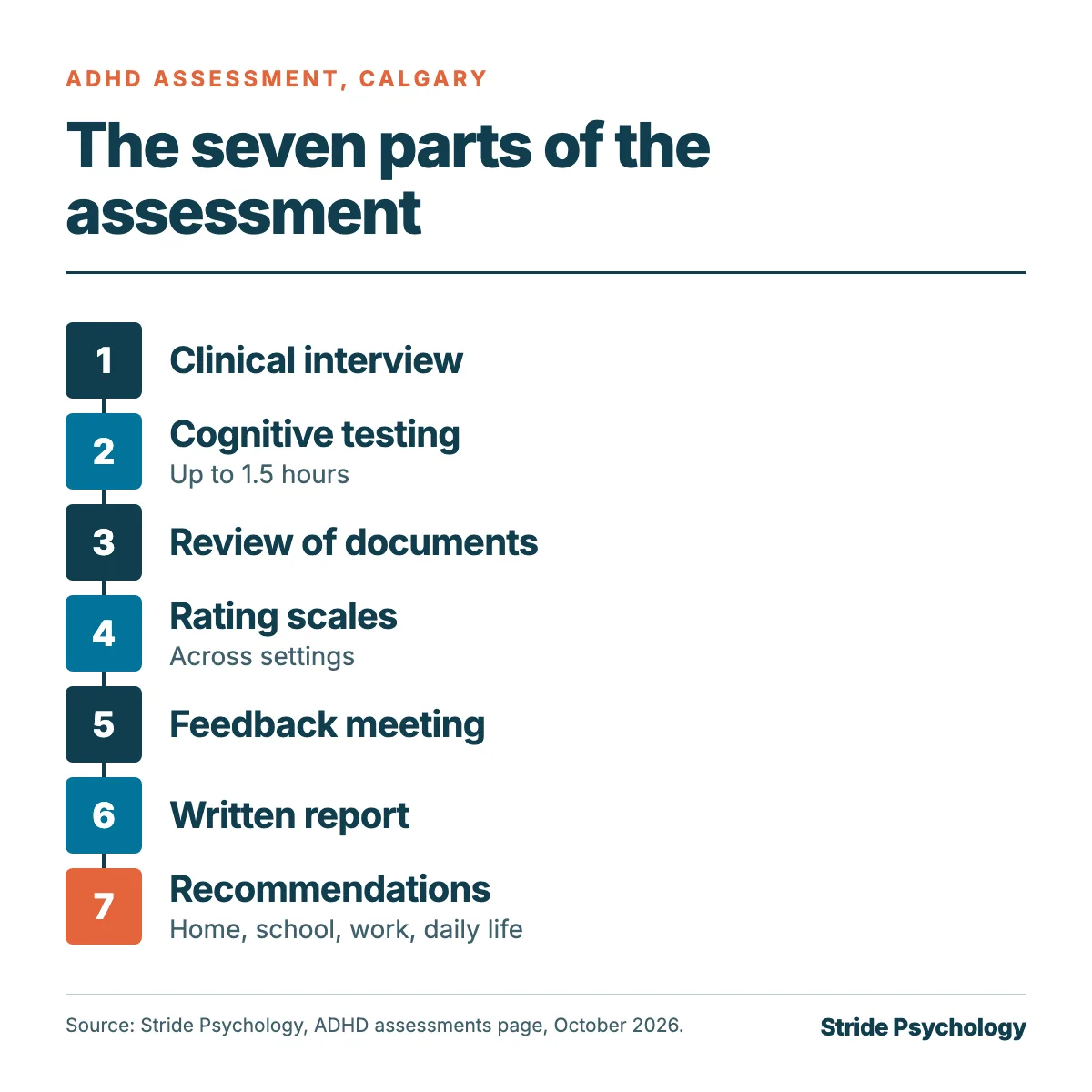
Every ADHD assessment at Stride Psychology has the same parts. They happen across more than one appointment, and your psychologist will tell you the order and timing for your situation.
- Clinical interview. A conversation about what you are noticing, when it started, and how it shows up at home, at school or at work. For a child, a parent is part of this conversation.
- Cognitive testing. Structured tasks that look at attention, memory, processing and problem solving. This takes up to 1.5 hours.
- Review of documents. Report cards, past evaluations and other records, if you have them. They show how long the pattern has been there and where it appears.
- Rating scales. Short questionnaires about symptoms and functioning in different settings. For a child or teen, a parent and a teacher usually complete one each. For an adult, the scales ask about daily functioning at work, at home and in relationships.
- Feedback meeting. Your psychologist explains what the testing found and what it means, and answers your questions.
- Detailed written report. The findings in writing, with the reasoning behind them.
- Personalized recommendations. Accommodations and strategies for home, school, work and daily life, written for your situation.
How Does an ADHD Assessment Differ for Children and Adults?
The steps stay the same. The information we gather depends on who is being assessed.
For a child or teen, we look closely at school functioning and behaviour, and we ask parents and teachers for their view, because attention often looks different in a classroom than at the kitchen table.
For an adult, we focus more on daily functioning, on work or post-secondary demands, and on relationships. We also ask how long the pattern has been there and where it shows up.
In every assessment, we look at how the concerns show up across different areas of life: at home, at school or work, and in relationships.
What Happens If the Result Is Not ADHD?
Not every assessment results in an ADHD diagnosis, and that is okay. You still receive the full written report, with what the testing found and what it means, and the recommendations still apply to the difficulties you came in with. Understanding what is going on is the goal, whatever the outcome. Sometimes the assessment points toward a learning difficulty, anxiety or something else, and the report says so and suggests a next step.
What Can I Use an ADHD Assessment Report For?
Families use the report to request school accommodations. Adults use it for workplace supports or post-secondary accommodations. It can support an application to a funding program, and it gives your family doctor or another health provider a clear picture to work from. It also gives you language for your experience, which, for many people, is its own form of relief.
Does Insurance Cover an ADHD Assessment?
Most individual insurance plans provide coverage for assessment and counselling services. If your plan covers psychological services, psychology, psychotherapy, counselling, or similar services, you can submit your receipt from Stride Psychology for reimbursement.
While Alberta Health Care does not currently cover these services, they may qualify as medical expenses on your tax return. Your receipt can also be used for tax purposes. The current fee is on our Fees page.
How Do I Book an ADHD Assessment in Calgary?
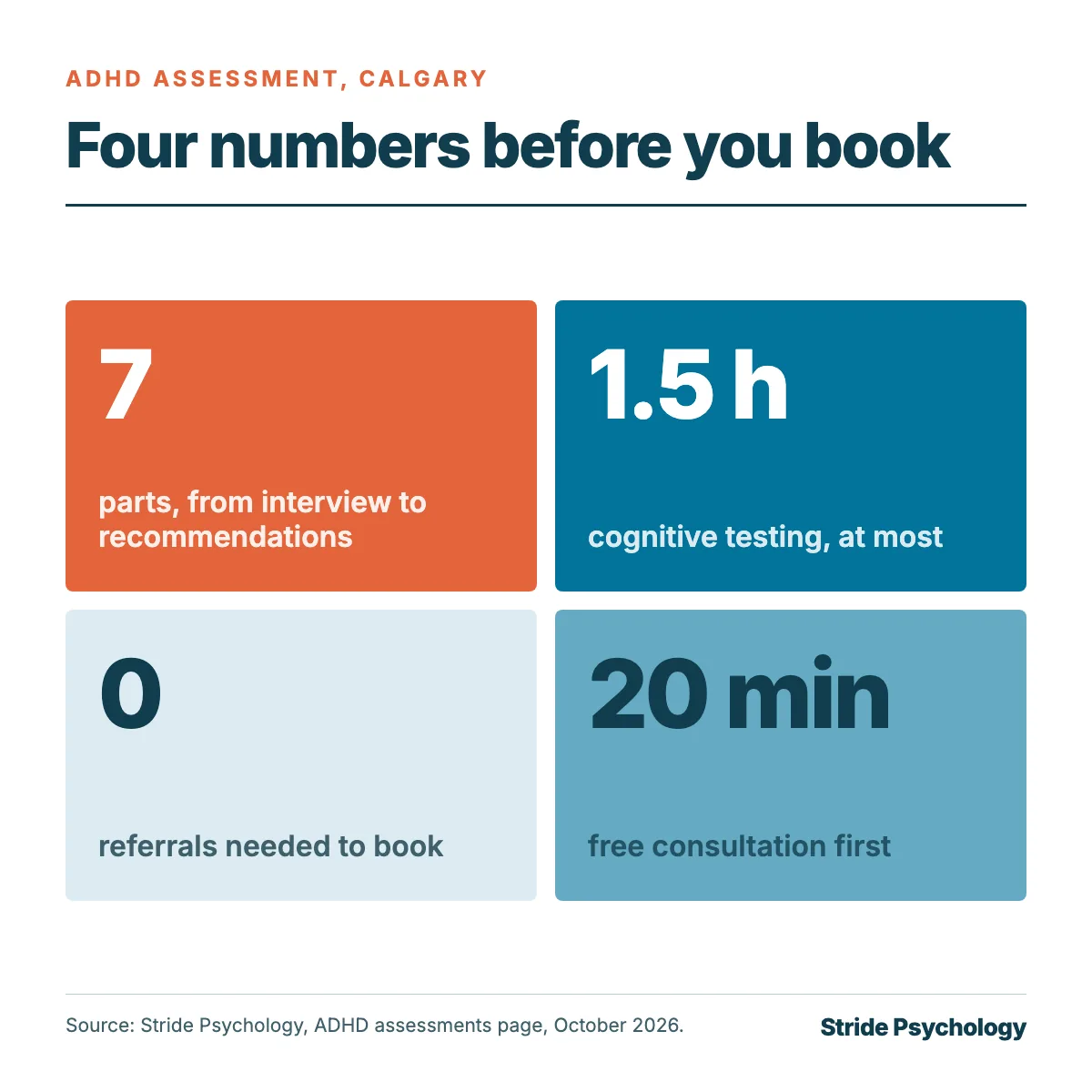
Reach out through our contact page or call us. Most people begin with a free 20-minute consultation, where we talk about what you are noticing and whether an assessment is the right next step. If it is, we book the first appointment from there. If a different service fits better, we say so.
Sources
- Attention-Deficit/Hyperactivity Disorder (ADHD), National Institute of Mental Health (United States)
- Canadian ADHD Practice Guidelines, guideline overview, Canadian ADHD Resource Alliance (CADDRA)